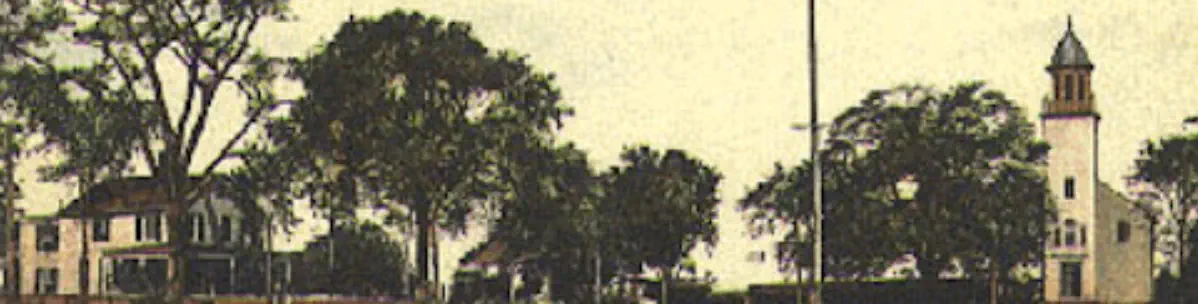



History of Orange
The history of Orange is actually part of the early history of Milford. Having been founded by Peter Prudden, a member of the Quinnipiac (New Haven )Colony and his followers in February of 1639, Milford lands were purchased from the sachem of the Paugusett Indian Tribe, Ansantawae whose village ran along the banks of the Wepawaug River. The price for land at that time usually amounted to a number of coats, blankets, kettles, hatchets, knives, hoes, mirrors and other items foreign to the native Americans at that time. Title to the region was based solely on land purchases from the Indians and not upon any grant from the English Crown. Later purchases, some of which were spearheaded by Alexander Bryan, increased the original boundaries. It was not until August of 1639, that the settlers, from the New Haven Colony, formed the First Church of Milford.
Life in the little village known then as Wepawaug, was simple but not without toil, the majority of its members being farmers with a few skilled artisans. In addition to leadership, Alexander Bryan was an enterprising sea merchant and as early as 1640 had established a fur trade to Boston. By the end of 1640, the little village changed its name to Milford.
Milford grew rapidly during the latter part of the 17th century with Richard Bryan Jr. buying 208 acres to the north of the original colony referred to as North Milford, naming his portion, Bryan's Farms. The 208 acres encompassed the area now bounded by Orange Center Road, Old Tavern Road, Porter Lane and Lambert Road. The section referred to as North Milford of which Bryan's Farms formed a portion, began to feel the pressures of attending church over 5 miles away in all types of weather.
Just as the church had been a strong force in the establishment of the 1639 colony of Wepawaug (Milford) so was the church a strong influence in the establishment of an independent North Milford. In 1804, this section applied to the State Legislature for a charter to form a church of its own. In 1796 , it had been permitted to erect a small building in which pastors conducted services on a limited basis but there was strong opposition for this to become permanent. However a charter was granted in October of 1804 and the North Milford Ecclesiastical Society came into being.
The incorporation of North Milford, in 1822 does not stand alone, as the history of West Farms (West Haven) became a part of the story with its settlers moving westward from the New Haven Colony. The union of two ecclesiastical societies created an area named Orange, each with its descendants from the earliest settlements, West Haven section being referred to as the West Haven Parish and Orange Center, the Orange Parish. The name Orange, reaches into the past with the despotic English King , James II, who commissioned Edmund Andros to seize the Connecticut Charter. After many hours of discussion, well into the night, the lights went out and the charter disappeared from the table. It was, as the story goes, placed in an old oak tree. We note a use of Charter Oak in many of Connecticut's bridges, streets and the like. In the meantime, Prince William, of the Netherlands, having married James' daughter Mary Stuart, was put into power by both the Whigs and the Tories in what was to be known as the Glorious Revolution in 1688. It was, the memory of kindnesses of Prince William of Orange that the two Parishes became Orange.

It is of interest that as early as 1848, a division of the Town of Orange was being considered to divide the town into two towns but it appears that an affirmative vote was not presented to the General Assembly. In 1903 , the division was discussed again and in 1907 a tentative charter, creating the City of Orange was passed by the General Assembly, the restriction being an agreement by the voters. The referendum was defeated in September of 1907. By 1916, a resolution was passed to draft a new charter and it was not until 1921, that West Haven and Orange were separated by a special act of the General Assembly in June of 1921. Names such as Treat, Clark, Andrew , Russell, Stone, Bryan, Woodruff and Baldwin are significant in our history but one can look at the names that appear in our town today, to see the future of the Town of Orange.